a Claude Code and Codex plugin

Collaborate with your agent in HTML.

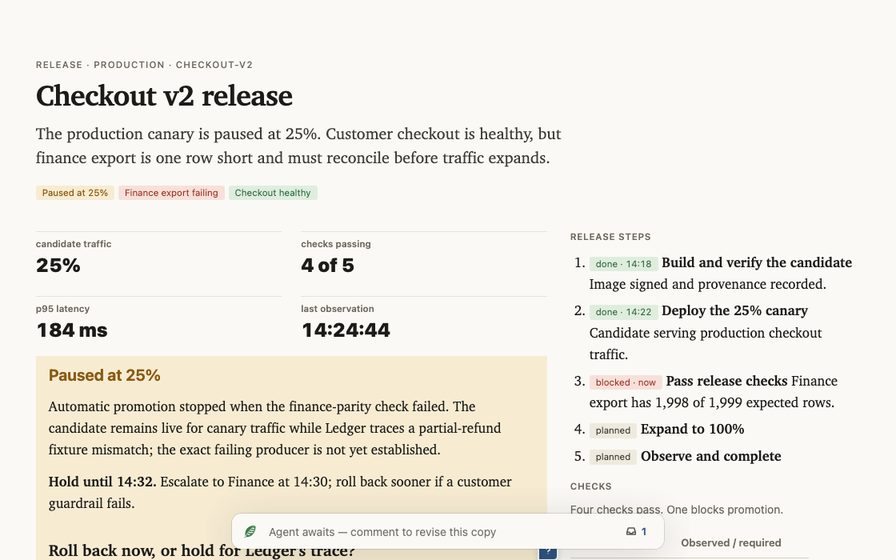
Your agent builds you a page rather than a scroll of terminal text: diagrams, boards you drag, a list of work that ticks over as it goes. Select any line and comment on it like a shared doc; the comment reaches the session, and a revised version arrives with the change.

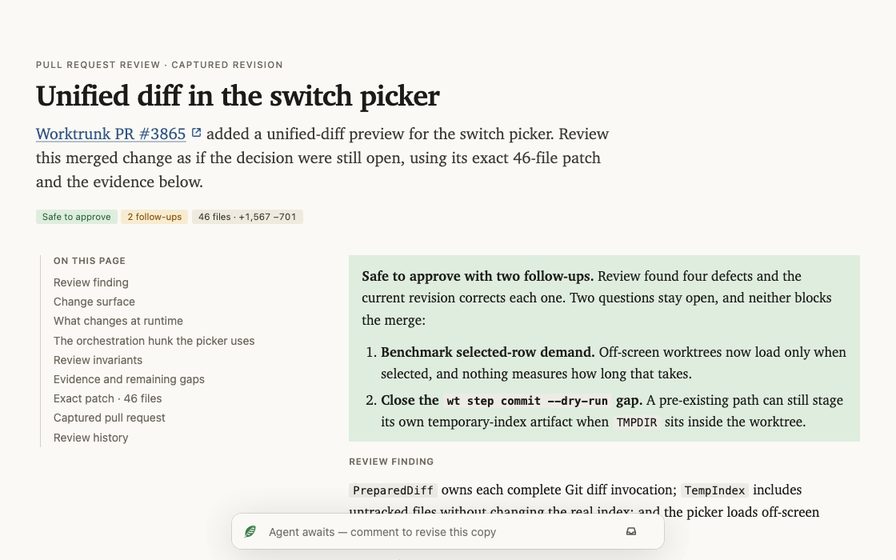
It works for anything that would otherwise land as a wall of terminal text: a migration plan, an architecture write-up, an incident diagnosis, a PR walkthrough, a review, or a list of things to work through that ticks over as the agent does them. Two commands install it. No accounts, no daemon, no config; you need uv on your PATH and a browser on the same machine.

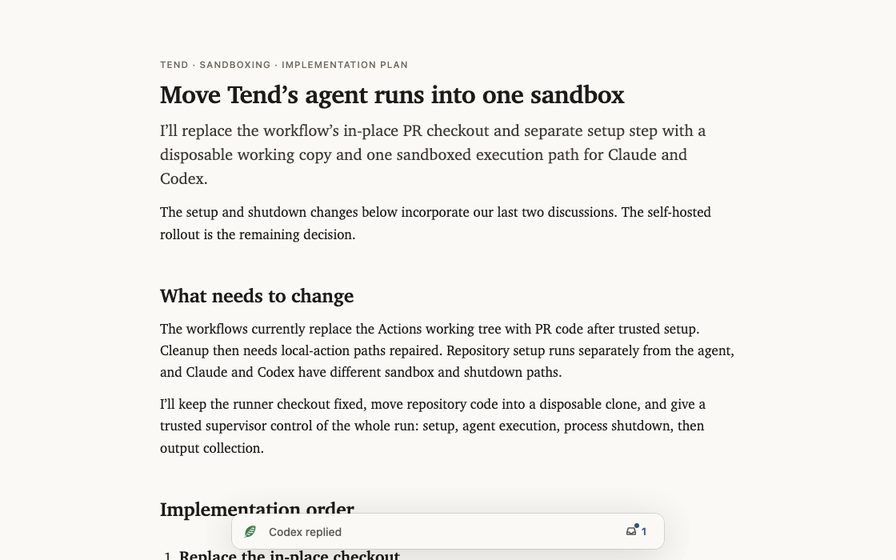
A live leaf in the browser: a migration plan with a comment anchored
to a highlighted passage, Claude's reply in the thread, a version picker reading
v2 (latest), and a banner reading 'Claude awaits'.
A leaf in flight. The user asked about a rollback edge case; Claude replied in the thread and shipped v2 covering it. The picker holds each immutable version with its changelog and a Δ that marks what changed since it, and the banner tracks whether Claude is working or waiting on you.

What a page can do

The examples are complete pages, one per kind of write-up, published here as the browser draws them. How it works shows the widget system rendering live, and Customize covers theme overlays and project widgets.

Example: Review a plan

  1. Ask. "Write up the migration options as a page" triggers it, as does /leaf in Claude Code or $leaf in Codex. The agent writes the page, serves it on a loopback port, and prints the URL.
  2. Mark it up. Select any passage and comment; the passage stays lit while you write, and the comment anchors to it and stays anchored as versions change — to the passage you picked, even where the page says the same thing twice. Diagrams and images take comments by click, and a suggestion mode proposes replacement text that the agent takes verbatim or answers with why not. The agent opens threads the same way — a question about one sentence arrives in the margin beside it, not in the terminal.
  3. Your comment reaches the session. On Claude Code, a background leaf wait wakes or joins the agent. On Codex, the agent keeps the handover turn active and polls the exact wait session. Either way it acknowledges only after a complete, untruncated batch is in model context, so "printed" cannot masquerade as "seen".
  4. A revision ships. Versions are immutable, each with a one-line changelog. The page follows the newest while keeping your place on it, and any older version's Δ marks every passage that has changed since it — as far back as you were away.
  5. Conclude deliberately. Pages seeking approval offer "✓ Looks good"; comments-only pages offer a neutral "End leaf" instead. Approval records assent and can leave the page live for follow-up; ending comments is a separate event. After either complete batch is received, an explicit idle state closes the agent loop when its work there is finished. leaf transcript prints the whole thread as Markdown for a PR description.
A live leaf page. The user selects Backfill history and writes a
comment while the passage stays highlighted. The agent replies, publishes a new version
whose rehearsal count advances, and the user drags an on-call task to During.
The real loop, recorded by scripts/record-demo.sh: comment on a passage, watch a new version advance the work, then move a card.

Example: Re-prioritize a queue

The release-triage example hands the ordering to the user. Run the shipped page from a checkout, then drag “CSV export quotes numerics” from “Fix in 2.4.1” to “Blocking release”:

scripts/preview.py triage-board
Migration reruns on every deploy The version stamp never lands. Logout fails with an expired session The session key is deleted twice. CSV export quotes numerics Breaks one downstream import.
The browser sends the placement as structured detail: {"widget":"release-board","action":"move","detail":{"card":"card-export", "to":"col-blocking","index":2}}. The move appears immediately, reaches the agent as an action, and remains on later versions.

Example: Watch work finish

The cutover-rehearsal example is a page the agent keeps current while it works. It names what is running now, separates blocked work from the critical path, and records completed checks. Run it like any other example:

scripts/preview.py live-progress
  1. v4: 11 of 18 checks are done; traffic has just moved to the new checkout service.
  2. v5: 14 are done; rollback is running, so that milestone becomes active and the event timeline gains the cutover result.
  3. v6: rollback is done; the report becomes active and the browser follows the version without a reload.

The published example is the middle state, with metrics, milestones, a blocker, and an event log for the next version to update in place.

Install

Claude Code

/plugin marketplace add max-sixty/leaf
/plugin install leaf@leaf

Codex

codex plugin marketplace add max-sixty/leaf
codex plugin add leaf@leaf

Then ask the agent to "write it up as a page", run /leaf in Claude Code, or run $leaf in Codex. The agent also reaches for it on its own when a plan or write-up would be easier to review as a page than as terminal text.